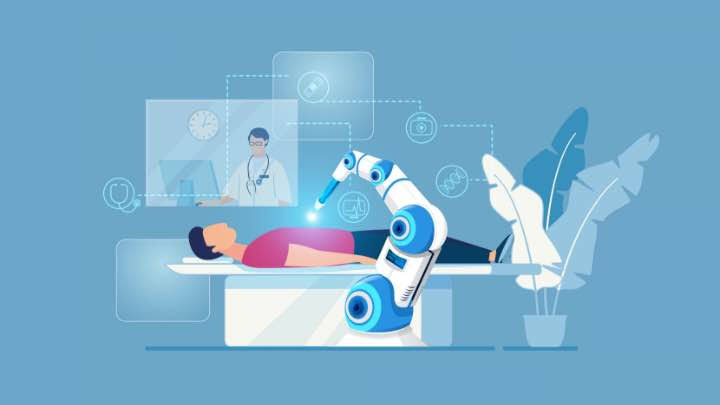
Artificial Intelligence (AI) has made significant advancements in many industries, and healthcare is no exception. In recent years, AI has proven to be a valuable tool in improving patient outcomes and streamlining medical processes. The use of AI in healthcare is expected to grow significantly in the coming years, with a market estimated to reach $34.27 billion by 2026. In this blog post, we will explore the impact of AI in healthcare, its benefits and challenges, and the future outlook.
One of the most significant benefits of AI in healthcare is improved diagnosis. AI algorithms can analyze vast amounts of data and identify patterns that human doctors might miss. This is especially important in radiology, where AI can assist radiologists in detecting diseases such as breast cancer, lung cancer, and heart diseases. AI can also help doctors in making more accurate diagnoses by analyzing medical images and providing a second opinion.
Another benefit of AI in healthcare is personalized medicine. AI algorithms can analyze a patient’s medical history, lifestyle, and genetic information to provide personalized treatment plans. This is particularly helpful in cases where traditional treatments may not be effective. Personalized medicine not only improves patient outcomes but also reduces healthcare costs by avoiding ineffective treatments.
AI can also assist in reducing the time it takes to perform various medical procedures. For example, AI algorithms can quickly analyze large amounts of data and make recommendations for treatments, freeing up time for doctors to focus on more critical tasks. Additionally, AI algorithms can automate routine tasks, freeing up medical staff to focus on more critical tasks.
One of the challenges of AI in healthcare is the potential for biased algorithms. AI algorithms are only as good as the data they are trained on, and if the data is biased, the algorithm will produce biased results. This can lead to inaccurate diagnoses and ineffective treatments. To overcome this challenge, it is essential to ensure that the data used to train AI algorithms is diverse and free of bias.
Another challenge of AI in healthcare is the cost. Implementing AI technology in healthcare requires significant investment, and many healthcare facilities may not have the financial resources to do so. Furthermore, there is a shortage of trained professionals who can develop, implement, and maintain AI algorithms, further driving up the cost of implementing AI in healthcare.
Despite these challenges, the future outlook for AI in healthcare is bright. As AI technology continues to advance, the cost of implementation is expected to decrease, making it more accessible to healthcare facilities of all sizes. Additionally, advances in AI algorithms will lead to improved accuracy and increased efficiency, further improving patient outcomes.
In conclusion, AI has the potential to revolutionize healthcare, improving patient outcomes and streamlining medical processes. While there are challenges to overcome, such as the potential for biased algorithms and the high cost of implementation, the future outlook for AI in healthcare is bright. As AI technology continues to advance, it is expected to play an increasingly important role in the healthcare industry, providing personalized treatments, reducing medical costs, and improving patient outcomes.
Keywords: Artificial Intelligence, healthcare, patient outcomes, medical processes, diagnosis, personalized medicine, medical procedures, biased algorithms, cost, future outlook,Artificial Intelligence,Cyber security,Machine learning,Data breaches,Threat detection,Malware,Network security,Cyber attacks,AI and security,Data security,Cloud security,Endpoint security,Information security,Vulnerability management,Identity and access management,Encryption,Internet security,Firewall,Security analytics,Risk management.
Facts
1- The use of AI in healthcare is expected to grow significantly in the coming years, with a market estimated to reach $34.27 billion by 2026.
2- AI algorithms can analyze vast amounts of data and identify patterns that human doctors might miss, leading to improved diagnosis.
3- Personalized medicine, where AI algorithms can provide personalized treatment plans based on a patient’s medical history, lifestyle, and genetic information, can improve patient outcomes and reduce healthcare costs.
4- AI can assist in reducing the time it takes to perform medical procedures and automate routine tasks, freeing up medical staff to focus on more critical tasks.
5- One of the challenges of AI in healthcare is the potential for biased algorithms, which can lead to inaccurate diagnoses and ineffective treatments.
6- The cost of implementing AI technology in healthcare is a challenge, as it requires significant investment and there is a shortage of trained professionals who can develop and maintain AI algorithms.
7- The future outlook for AI in healthcare is bright, as the cost of implementation is expected to decrease and advances in AI algorithms will lead to improved accuracy and increased efficiency.
8- AI has the potential to play an increasingly important role in the healthcare industry, providing personalized treatments, reducing medical costs, and improving patient outcomes.
 Ghost AI
One response to “Revolutionizing Healthcare: The Impact and Benefits of Artificial Intelligence”
[…] and benefits .. Read 11. AI in healthcare: Applications and benefits of AI in the medical field.. Read More.12. The economics of AI: Understanding the costs and benefits of implementing AI in business..Read […]
LikeLike